
Latest News
Four ways to construct a steel structure mezzanine
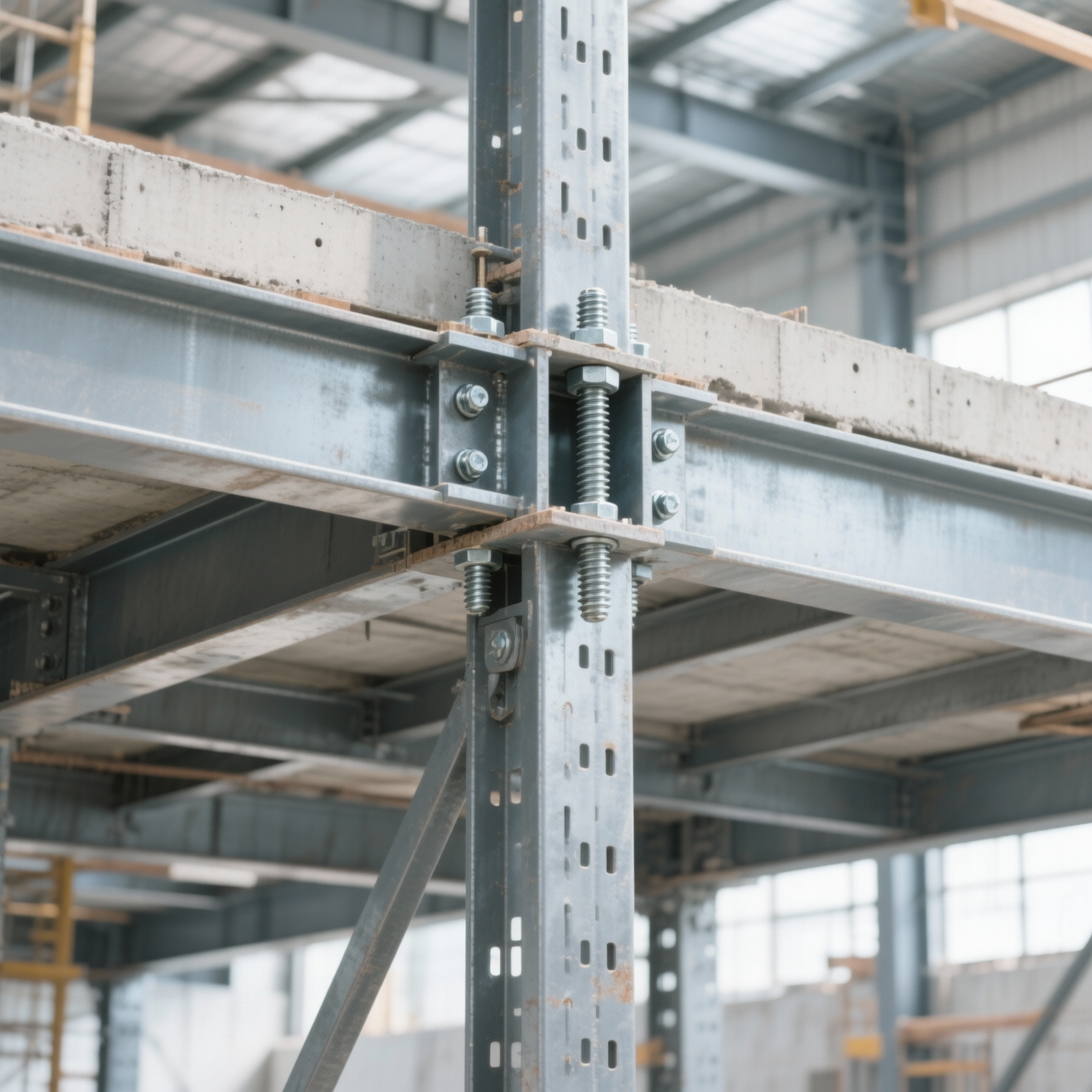
1. Rooting
One of the key aspects of the safety of steel structure mezzanine floors is "rooting." The "root" refers to the transfer of the load from the newly constructed steel structure mezzanine floor slab to the "roots" via the main beams, and from there to the existing structure. Just like a tree cannot stand without strong roots, in actual construction, the first step is to determine if the fixing points are load-bearing structures. Secondly, the hardness, thickness, and reinforcement of the original structure must be checked. (For non-load-bearing structures or those that cannot be constructed within the original structure, independent supports are required, but these independent supports must also be built on load-bearing beams and other components.) When drilling holes, avoid breaking the main reinforcement bars as much as possible, strictly adhere to the required depth and diameter for drilling, and configure anchor bolts according to the roof load. The hole must be thoroughly cleaned before inserting the anchor bolts; otherwise, the anchoring strength will be severely affected. The insertion speed should not be too fast, as this will cause incomplete mixing of the anchoring agent; too slow a speed will cause the agent to leak out, both reducing the pull-out force. After insertion, allow the installation time according to the temperature before proceeding with further construction. The embedded plate is a component of the anchor bolts. Its thickness and area are calculated based on the total load on the main beam (the anchor plate for reinforced concrete should be larger than that for high-strength bolts to compensate for the lower success rate of reinforced concrete). When welding the support plate or connecting plate, a section weld is required. Pull-out tests must be performed on the anchor bolts during installation. For bolts with low shear force, a soil test can be conducted. When drilling holes in all embedded plates, the possibility of reinforcement probing must be considered; more holes can be drilled than installed, but the total load must not be less than the design load. If there are gaps between the embedded plate and the concrete beam or column, they can be filled with adhesive or grout. The main beam can only be loaded after all anchor bolts have solidified.
2. Main beam
The main beam is the second key safety element in steel structure mezzanine engineering. Even if a tree has a good root system, it is useless if the trunk cannot withstand external forces. The selection of the main beam is directly related to the roof's load-bearing capacity and span. If the span is small, I-beams or H-beams can be used. After the steel beams are selected, they need to be ground, rust-removed, cut, and primed. After arriving at the site, the anchorage at both ends should be measured before fine cutting. Mezzanine engineering is different from other steel structure engineering. The length of most beams and purlins is not fixed, so they are cut after actual measurement. If the span is small, try to use steel sections.
3. Connection
The construction of steel structure mezzanine mainly involves the connection of steel beams, either through welding or high-strength bolts. In large projects, high-strength bolts or welding are generally used because the site and welding power supply allow it, so I won't go into details. However, on steel structure mezzanine construction sites, the space is often confined, making it difficult to access the main beams. Sometimes, the beams are even disconnected on the outside before being reconnected. Machinery is rarely used, and the beams are usually manually lifted and spliced before being hoisted and connected.
Method 1: Steel structure cement pressure board composite floor slab
Construction method: Secondary beam purlins (spacing approximately 600mm) + cement fiberboard (or OSB board) + approximately 40mm thick fine aggregate lightweight concrete (optional) + decorative surface layer;
This structural design has advantages such as low cost, light weight, and short construction period; it is suitable for mezzanine renovations in residential buildings, office buildings, and industrial projects; however , it should be carefully considered when there are large floor loads or vibration loads.
Method 2: Steel-concrete composite floor slab
Construction method: Steel structure floor deck + approximately 100mm thick reinforced concrete slab + decorative surface layer;
This solution features high safety, large load-bearing capacity, no vibration, and good sound insulation. However, it has a slightly longer construction period and a larger floor weight. It is suitable for building layouts of varying sizes, such as residential buildings, office buildings, various factories, and floors subject to heavy and vibration loads, making it the most widely applicable solution.
Method 3: Steel structure lightweight panel composite floor slab
Construction method: Approximately 100mm thick ALC aerated concrete board + approximately 30mm thick post-mortar leveling layer + decorative surface layer;
This structural combination scheme is safe and environmentally friendly, lightweight, high-strength, durable and deformation-free, quick to construct, has a short construction period, and provides good thermal insulation and soundproofing. It can also be installed at the same height as the upper flange of the steel beam, maximizing the use of available space. It is suitable for office buildings, residences, and light industrial buildings; however, it should be used with caution in industrial projects with large floor loads or vibration loads.
Method 4: Steel structure and steel plate composite floor slab
Construction method: Secondary beam purlins (or stiffening ribs) spacing less than 600mm + patterned steel plate (or grating) + approximately 40mm thick fine aggregate concrete (optional) + decorative surface layer (optional);
This structural combination scheme is suitable for industrial plants, workshops, equipment rooms and other buildings. It has good load-bearing capacity and quick construction, but its thermal insulation and sound insulation effects are slightly inferior.
1. The principles for designing and constructing new mezzanine floors are:
(1) Take into account factors such as functionality, energy saving and heat preservation, sound insulation and noise reduction, and environmental coordination to select a suitable mezzanine floor form.
(2) Structural safety is paramount. The structural components should be calculated and analyzed to select appropriate beam and column cross-sectional forms and dimensions. The mezzanine structure should avoid connecting with the original structure's beams and columns as much as possible, and should not damage the original structure.
(3) The lighter the weight of the added mezzanine floor, the better, so as to reduce the self-weight load on the original structure;
(4) Convenient construction, and the less impact the construction operation has on other areas, the better;
2. Should the newly added mezzanine floor be constructed with a steel structure or a pure concrete structure?
Some homeowners ask whether to choose a steel structure mezzanine floor or a pure concrete mezzanine floor. In reality, the vast majority of new mezzanine floors are steel structure mezzanines (one of the four types mentioned above), and pure concrete mezzanines are extremely rare. The reasons are as follows:
(1) The most significant advantage of steel structure mezzanine floors is their light structural weight. Under the same conditions, the self-weight of concrete floor beams is 3-5 times that of steel structure floor beams; generally, the self-weight of a steel structure mezzanine floor is less than 100 kg/m² (steel structure concrete composite floor slabs are slightly heavier, reaching approximately 300 kg/m²), while the self-weight of a pure concrete floor slab is over 350 kg/m². The self-weight of a steel structure mezzanine floor is significantly lower than that of a pure concrete floor.
(2) Steel structure mezzanine floors are mostly dry construction, which is convenient, requires fewer construction measures, is fast, and has little impact on other surrounding areas. Pure concrete mezzanine floors require on-site scaffolding, formwork, rebar tying, and concrete pouring for beams and slabs. They involve more wet work, more construction procedures, more construction measures, longer construction periods, and have a greater impact on the surrounding environment.
Therefore, the vast majority of newly added mezzanine floors are steel structure mezzanines. So how should we choose among these four methods? We remind you that the specific type of steel structure mezzanine should be evaluated, calculated, and designed by a relevant steel structure company. The most economical and reasonable construction method for different uses or building types needs to be determined by professional designers!
Related Posts
Send Us A Message