
The Shandong Provincial Department of Housing and Urban-Rural Development issued the "Implementation Plan for Reducing Construction Waste in Shandong Province".
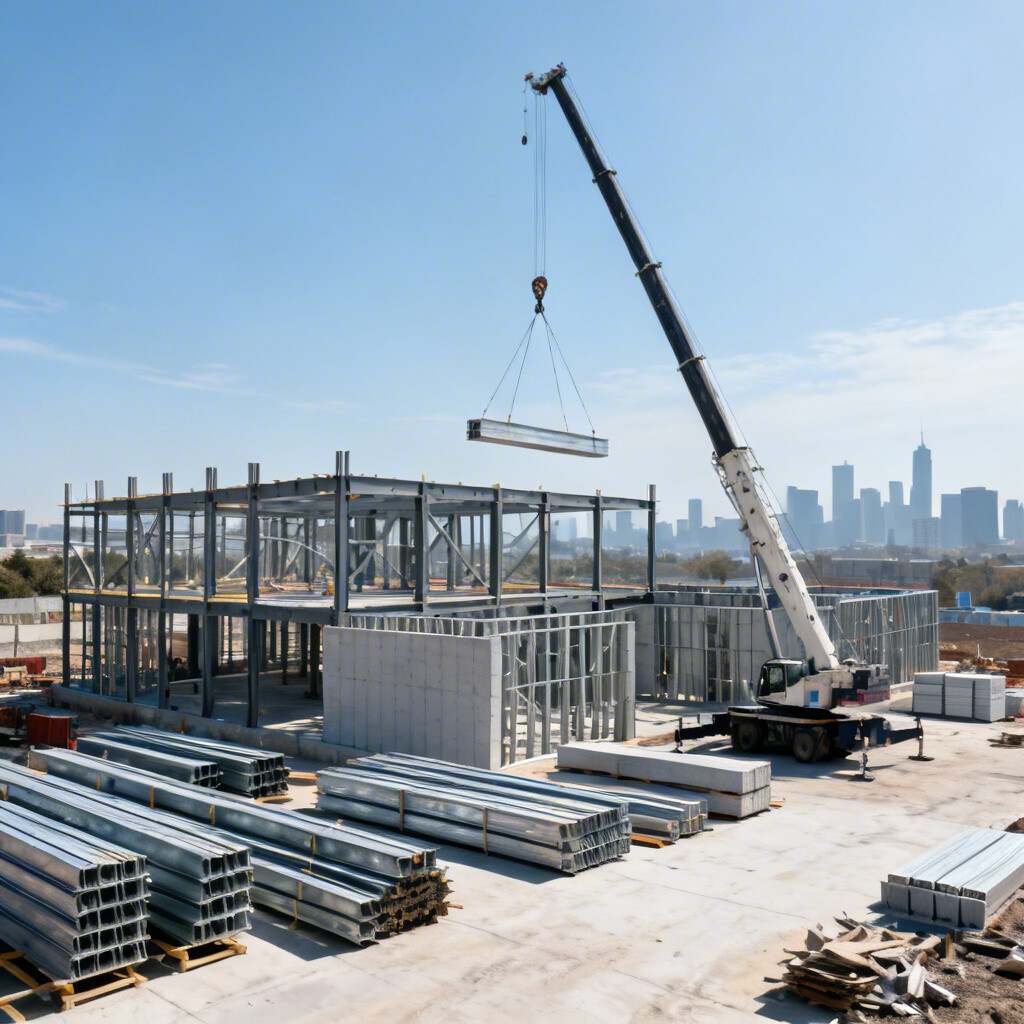
The Ministry of Housing and Urban-Rural Development of Shandong Province officially issued the "Notice on the Implementation Plan for Reducing Construction Waste in Shandong Province", which clarifies the specific amount of construction waste discharged in each region by the end of 2025: the amount of construction waste discharged at the construction site of new buildings shall not exceed 300 tons per square meter, and the amount of construction waste discharged at the construction site of prefabricated buildings shall not exceed 200 tons per 10,000 square meters.
Since all components of a steel structure prefabricated building are prefabricated in a factory, they only need to be transported to the construction site for installation to complete the construction. Therefore, the amount of waste generated by a steel structure prefabricated building is relatively small.
Environmentally friendly, energy-saving, and pollution-free, this is one of the reasons why prefabricated steel structures are being vigorously promoted by the state.
In order to implement the "Guiding Opinions on Promoting the Reduction of Construction Waste" (Jianzhi [2025] No. 46) issued by the Ministry of Housing and Urban-Rural Development , to do a good job in reducing construction waste, and to promote green construction and the transformation and upgrading of the construction industry, the following implementation plan is formulated in light of the actual situation in our province:
01 Work Objectives
By the end of 2025, the construction waste reduction mechanism in various regions will be established and further improved, so as to achieve that the amount of construction waste (excluding engineering spoil and engineering mud, the same below) discharged at the construction site of new buildings is no more than 300 tons per 10,000 square meters, and the amount of construction waste discharged at the construction site of prefabricated buildings is no more than 200 tons per 10,000 square meters.
02 Main Measures
(I) Promoting Green Planning
1. Implementing Corporate Responsibility. Adhering to the principle of "whoever generates it, is responsible for it," the primary responsibility of construction units for reducing construction waste must be implemented. Construction units should include construction waste reduction targets and measures in bidding documents and contract texts, include construction waste reduction measures costs in the project budget, and supervise the implementation by design, construction, and supervision units.
2. Implementing New Construction Methods. Vigorously develop prefabricated buildings such as steel structures. The planning and construction conditions for newly built urban civil buildings should clearly specify requirements such as the proportion, assembly rate, and evaluation level of prefabricated buildings. Government-invested or government-mainly-invested construction projects should be constructed entirely in accordance with prefabricated building standards, and the application of mature prefabricated components such as interior wall panels, prefabricated stair slabs, and prefabricated floor slabs should be continuously promoted. Innovative design, construction technologies, and equipment should be encouraged, and fully furnished delivery should be implemented to reduce the generation of construction waste on construction sites. Under the leadership of construction units, the application of technologies such as Building Information Modeling (BIM) in engineering design and construction should be promoted to reduce "errors, omissions, and deficiencies" in design and rework and rectification during construction.
3. Adopting New Organizational Models. Accelerate the reform of engineering construction organization and implementation methods, implement the guiding opinions on engineering general contracting and whole-process engineering consulting, study and formulate bidding documents and contract model texts, promote the orderly and standardized development of engineering general contracting and whole-process consulting services in the fields of housing construction and municipal engineering, strengthen the deep collaboration between design and construction, and build an organizational model conducive to promoting the reduction of construction waste.
(II) Promote green design
4. Implement the concept of green design. Implement the building policy of "applicable, economical, green and beautiful", take into account the durability and sustainability of the entire life cycle of the project, highlight the building's use function and energy-saving, material-saving and environmental protection requirements, prevent and reduce the generation of construction waste in the process of engineering construction from the source, and effectively reduce the emission of construction waste throughout the entire life cycle of the project. Encourage the use of high-strength, high-performance, high-durability and recyclable materials and advanced applicable technology systems in engineering design. Actively promote the application of green building materials. Government-invested or government-funded construction projects should give priority to the use of certified green building materials, and gradually increase the application ratio of green building materials in newly built urban buildings.
5. Improve design quality. Design units should reasonably determine the site elevation based on the engineering topography and geomorphology, conduct earthwork balance demonstrations, and reduce the transportation of excavated soil; select suitable structural systems to reduce the irregularity of building shapes; advocate the priority use of recycled building materials such as recycled concrete, recycled mortar, recycled bricks, and recycled pavement; and advocate integrated collaborative design of all disciplines including architecture, structure, electromechanical, decoration, and landscape to ensure that the design depth meets the construction needs and reduce design changes during construction. Based on the principle of "modular unification and modular collaboration", promote the standardization of functional modules and components, the integration of building accessories, and the modularization of pipeline equipment to reduce irregular and non-standard components. For renovation and expansion projects, encourage the full use of the original structure and original electromechanical equipment that meets the requirements.
(III) Promote green construction
6. Prepare special plans. Construction units should organize the preparation of special plans for the reduction of construction waste on the construction site, clarify the goals and division of responsibilities for the reduction of construction waste, and propose specific measures for source reduction, classified management, on-site disposal, emission control, and pollution prevention.
7. Strengthen design refinement and construction organization optimization. Construction units should actively utilize BIM and intelligent technologies, combining engineering processing, transportation, and installation plans with construction process requirements, to refine node structures and specific practices, optimize construction organization design, and rationally determine construction procedures. Promote digital processing and information management to achieve precise material cutting and meticulous management, reduce building material loss rates, and improve resource utilization.
8. Strengthen quality control during construction. Enhance the review of construction drawings, rationally arrange construction schedules, and reduce construction waste by improving construction standards and processes. Construction and supervision units should strictly control the quality of incoming materials and equipment according to design requirements, rigorously control construction quality, strengthen quality control at each stage, enhance on-site inspections, promptly identify and correct problems, and conduct thorough quality pre-inspections and concealed acceptance of each sub-item of the project during construction. Prevent shoddy workmanship, substandard materials, and reduced project quality during construction, and minimize rework or repairs due to quality issues. Strengthen the protection of completed works to avoid secondary damage.
9. Improve the reuse rate of temporary facilities and reusable materials. Construction site offices and dormitories should prioritize the use of reusable and detachable prefabricated temporary housing, as well as standardized and reusable work sheds, testing rooms, and safety protection facilities. The use of prefabricated site boundary fencing and modular temporary road slabs is encouraged. The use of modular formwork such as large formwork made of aluminum alloy, plastic, fiberglass, and other renewable materials, and steel-framed formwork is also encouraged. The use of recyclable and reusable materials such as steel sheet piles, steel-cement-soil mixing walls, and steel supports as foundation pit support materials is also encouraged. Construction units are encouraged to coordinate the allocation of temporary facilities and reusable materials within a certain area.
10. Reduce construction waste emissions at construction sites. Construction units should monitor and track the amount of construction waste generated in real time and take timely and targeted measures to reduce emissions. The use of on-site sediment separation and slurry dewatering pretreatment processes is encouraged to reduce the discharge of construction waste and slurry. The integration of fire risers, fire pools, lighting routes, roads, and fencing with permanent facilities should be fully considered to reduce construction waste generated from the demolition of temporary facilities.
11. Implement classified management of construction waste. Construction units should establish a system for the classified collection and storage management of construction waste, classifying construction waste and implementing classified storage, transportation, disposal, and utilization. Detailed classification of construction waste with an end-of-life disposal focus is encouraged. The use of information technology such as smart construction site monitoring platforms is encouraged to monitor the collection, storage, utilization, and transportation of construction waste in real time, and to establish electronic ledgers. Mixing domestic waste and industrial waste with construction waste is prohibited. Construction waste containing hazardous waste and subject to environmental monitoring should be treated in accordance with relevant environmental protection regulations.
12. Improve the resource utilization level of construction waste. For generated construction waste, based on site conditions, priority should be given to on-site processing, backfilling, filling depressions, using soil for landscaping, or creating artificial hills for waste reduction, and dust suppression measures should be implemented. Construction waste that cannot be utilized on-site should be promptly transferred to a waste disposal site with appropriate capacity for resource recovery and reuse, as required. Strengthen the transportation management of construction waste for disposal, and prevent unauthorized dumping and spillage. Increase efforts to promote recycled building materials, and prioritize the use of recycled building materials that meet quality standards in government-invested municipal infrastructure, sponge city construction, and housing construction.
03 Organizational Safeguards
(I) Strengthen Organizational Leadership. Each city should establish and improve a working mechanism for reducing construction waste, led by the housing and urban-rural development authorities and with the participation of relevant departments. Implementation plans should be formulated based on local conditions to accelerate the reduction of construction waste at its source. Environmental sanitation authorities at all levels should coordinate the establishment and improvement of a construction waste management system, further strengthening the management of construction waste collection, transportation, resource utilization, and disposal.
(II) Enhance Technical Support. Innovation in construction waste reduction technology and management should be encouraged, and the rapid transformation and application of innovative achievements should be supported. A quota for construction waste emissions in Shandong Province should be developed, and relevant standards for the classification, collection, statistics, disposal, and recycling of construction waste at construction sites should be developed and improved.
(III) Strengthen Supervision and Guidance. Construction waste reduction should be incorporated into green construction and civilized construction practices. The establishment of a system for publicizing construction waste emissions at construction sites should be encouraged. A guidance manual for construction waste reduction should be implemented, and model projects for construction waste reduction should be actively created to guide and promote the in-depth development of construction waste reduction work.
(IV) Increase Publicity Efforts. The guiding role of public opinion and media supervision should be fully utilized. The importance of construction waste reduction should be publicized through newspapers, television, radio, the internet, and other media. Basic knowledge related to construction waste reduction should be popularized, and a working atmosphere of common concern and support from all parties should be actively created.
Related Posts
Send Us A Message