
Latest News
Some Thoughts on Steel Structure Detail Design
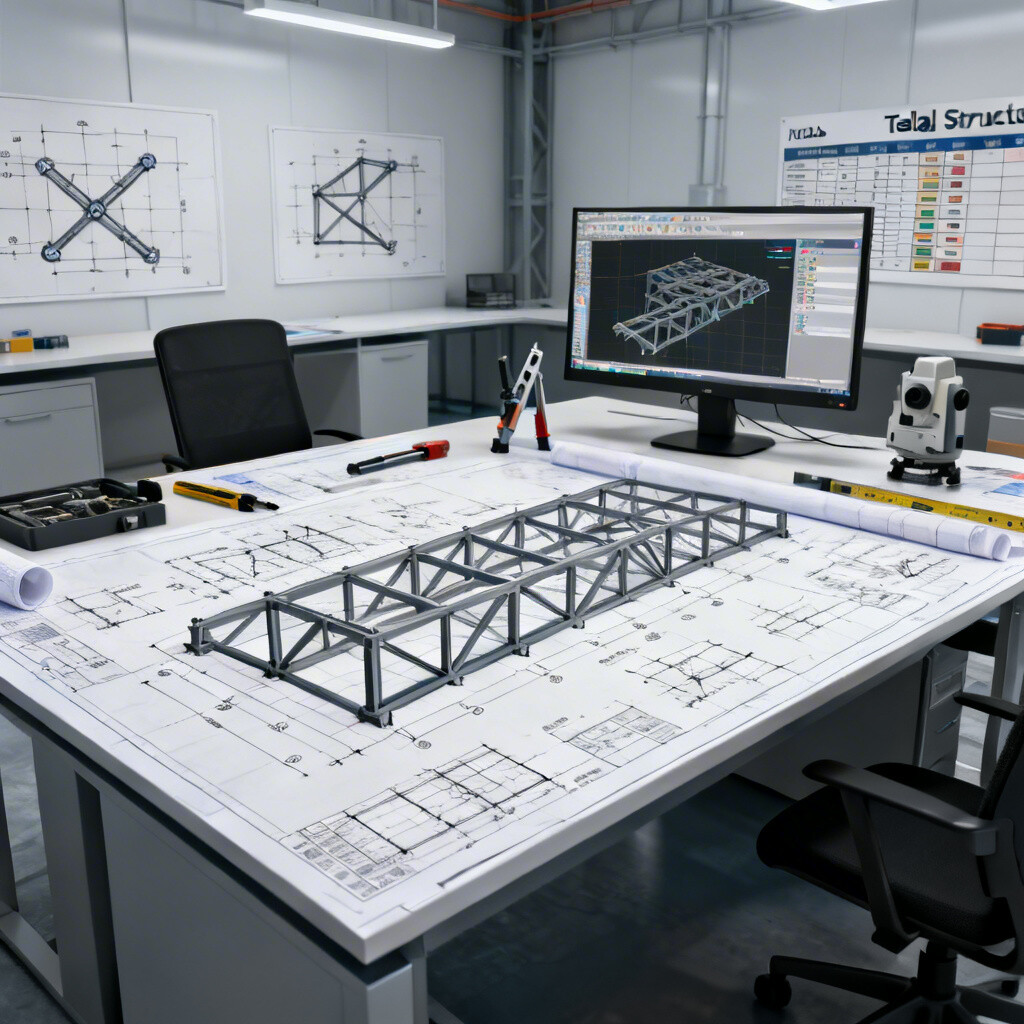
With the increasing use of steel structures in the construction field, the importance of detailed steel structure design has gradually become apparent. It is one of the main links in steel structure engineering, and the quality of this link directly affects the production cost, quality, and schedule of the steel structure.
I. Detailed Design Contents and Tools for Steel Structures
1.1 Content and Requirements of Detailed Design
Typically, a complete set of steel structure drawings should include a drawing catalog, general design specifications, component layout drawings, and component details.
1.1.1 The general description should include the project overview, material requirements, weld grade and quality requirements, component fabrication requirements, painting requirements, installation requirements (e.g., initial and final torque requirements for high-strength bolts), and other relevant information. The description should be clear, concise, and easy to understand.
1.1.2 The component layout drawings should be flexibly distributed according to the actual situation of the project. The layout drawings should be clear and accurate, and the details should be consistent with the content expressed in the layout drawings.
1.1.3 The most representative elevation should be selected as the main view in the component detail drawing. The component view should include the component's installation location and orientation, and the view shown should fully express the component's characteristics. All material numbers in the component should be correct, and the bolt specifications, hole diameters, weld types, sizes, and bevel types should be indicated in the drawing. For extra-long or extra-heavy components, the segment locations need to be determined. When determining the segment locations, the capacity of transport vehicles and lifting equipment should be considered first, followed by the rational use of materials and the staggering of weld positions at joints.
1.2 Commonly Used Software Tools
Detailed design relies heavily on software tools. Commonly used software includes Tekla Stuctures, Solidworks (for detailed design of mechanical steel structures), and AutoCAD. Other auxiliary software includes Tianzheng Structure, Explorer, and Truetable.
Tekla Stuctures is a widely used software that employs 3D modeling and allows for collaborative work across multiple users. During modeling, it allows for checking the positions of nodes and components, and automatically creates material lists, component statistics tables, and drawings. Its advantages include significantly reducing the labor intensity of drawing and minimizing dimensional errors caused by manual drafting; it also automatically generates detailed parts lists. Its disadvantages include a large number of component numbers, a high volume of drawings, a relatively high price for 3D detailing software, and a complex operation requiring considerable learning and practice, thus limiting its widespread adoption in Northwest China.
AutoCAD is the most commonly used software for detailed drawing design, but its operation is based on 2D models, lacks basic elements and many functions, requiring integration with other software and manual assistance to complete the drawing. Therefore, the drawing time is long, the error rate of the drawings is relatively high, and the workload is heavy. Its advantages are that the output volume can be flexibly controlled, and the layout and expression of the drawings can be freely arranged.
Software such as Tianzheng and Explorer can be used in conjunction with AutoCAD, and their convenient column grid layout, axis labeling, weld labeling, elevation labeling, and dimension labeling can greatly reduce AutoCAD drawing time. Truetable is software that converts between Excel and AutoCAD; its application can save time in compiling material lists, improve the accuracy of material lists, and make quantity calculations and statistics on drawings much easier.
Solidworks is primarily used for detailed design of mechanical steel structures, and it has strong capabilities for detailed design of gears, curved thin-shell sheet metal, and three-dimensional cast steel parts.
II. Common Problems and Solutions in Steel Structure Detail Design
2.1 Preparatory work for detailed design
Regardless of whether 3D modeling software or AutoCAD software is used, the final review of drawings is still controlled by technical personnel. Based on years of work experience, the following pre-control measures can better ensure the accuracy of detailed drawings.
2.1.1 Upon receiving the design drawings, one should first carefully understand the designer's intentions. Understanding the design drawings involves two aspects: firstly, understanding the design concept, and secondly, considering the complexity and feasibility of translating the design drawings into actual component manufacturing. Steel structure design drawings are mostly designed by steel structure design software (PKPM, 3D3S, etc.) and automatically generated. Some designers lack experience, and problems often arise in the design: for example, a project may have many specifications and types of materials, including some uncommon and difficult-to-procure materials. When encountering these problems, a material substitution application should be submitted in a timely manner to prevent unnecessary waste in the project; there may also be unreasonable or difficult-to-implement node designs, or the technical requirements in the design drawings may be too low, too high, or have redundant clauses. When encountering these problems, one should communicate with the designer in a timely manner to discuss appropriate changes and improve the manufacturability so that the next step of manufacturing can proceed smoothly.
2.1.2 Secondly, a reasonable drawing plan should be prepared. Detailed design work should be closely coordinated with the construction organization. In particular, for large steel structure projects, detailed design, material procurement, production, and finished product delivery should be arranged according to the construction schedule. There should be no interference between civil construction and steel structure installation, or components that are not compatible upon arrival, making installation impossible or unable to be installed into a stable system, which would cause safety hazards. For example, some construction units installed independent steel columns only to meet the schedule because steel beams, tie rods, supports, and purlins had not been delivered to the site. Without taking adequate safety measures such as guy ropes, the steel columns were very likely to break under sudden strong wind loads.
2.2 Common Errors in Detailed Drawing Design
2.2.1 The more serious errors include:
① The cross-sectional dimensions or material of the component do not match the design drawings; ② The component length is incorrect; ③ The joints at the nodes of columns, beams, etc. are incorrect, i.e., the node plates at the joints are incorrect and cannot be installed; ④ The component number and version are incorrect; ⑤ The component position is incorrect; ⑥ At the joints of the components, the joint positions are too concentrated and the weld positions are not staggered, etc.
2.2.2 Other common errors include:
① Dimensional discrepancies: The sum of the second and third dimensions does not match the first dimension; ② Inconsistent component numbers between the drawing and the material package and drawing frame; ④ Missing parts in the material list; ⑤ In some large projects, with a large number of components, component drawings are prone to duplicate drawing or omission; ⑥ Duplicate numbering of different components; ⑦ Incorrect bolt hole and connector hole positions; ⑧ Reversed connection plates of correct components, such as single-sided corner braces and supports, with the connection plates placed on the wrong side; ⑨ Wall purlins are placed in opposite directions at the upper and lower edges of door and window openings, which can easily lead to errors in calculating the length of wall corner braces and tie rods.
2.3 Techniques for Detailed Drawing Design
Common problems in drawings can be largely resolved by carefully understanding the design drawings, thoroughly checking them after completion, and passing the drawing review. Steel structure workshops often use color steel plates for structural cladding. The installation of these color steel plates should be considered in the structural detail design. Anticipating the following issues will significantly reduce the probability of errors in the drawings or interference with subsequent processes.
2.3.1 For components with hole requirements or control requirements, closed dimensions should not be marked when dimensioning. See Figure 1 below: Purlin drilling diagram; Figure 2: Frame column connection plate assembly diagram.
2.3.2 Several issues need to be considered when using internal gutters on the roof. First, the tie rods should not be designed to be flush with the top of the columns, otherwise the downpipes may not be installed properly. Second, the positions of the downpipes, tie rods, and inter-column supports should also be considered in advance; otherwise, during installation, they may hit either the tie rods or the inter-column supports. Third, the position of the wall purlins at the internal gutter location should be adjusted according to the gutter dimensions, otherwise the gutter cannot be fixed after the wall purlins are installed. See Figure 3: Internal Gutter Detail Diagram.
2.3.3 Do not misunderstand the need to consider factors such as "tension side" and "compression side" when drilling tie rod holes on purlins. Drilling holes with unequal spacing on the upper and lower sides may not be correct in the drawings, but it is very easy to install them backwards, which is actually detrimental. Therefore, it is advisable to drill symmetrical holes on purlins.
2.3.4 The position of the turnbuckles on the horizontal supports should be reasonable and not too far from the steel beams. Ease of installation should be considered; otherwise, workers will have to lean out to tighten them or climb ladders during installation, or climb up to tighten them after the purlins are installed, which is very unsafe. Horizontal supports are also prone to interfering with the position of corner braces, which should be considered in advance during the design phase.
2.3.5 The arrangement of high-strength bolts should be reasonable, taking into account the working space of torque converters and torque wrenches. Otherwise, due to insufficient space during installation, tools such as torque converters and torque wrenches cannot be positioned, resulting in the high-strength bolt spline heads not being able to break off or the high-strength bolts not being able to be tightened.
2.3.6 If possible, high-strength bolted connecting plates should use a symmetrical bolt arrangement, with bolts arranged at the top and bottom. In one project, a connection node used four bolts at the top and six at the bottom. During fabrication, the workshop workers accidentally assembled a portion of the connecting plates backwards, making it impossible to assemble on site.
2.3.7 Spring plate connections should be used as much as possible when connecting wind-resistant columns and steel beams. This is because the beams in the middle span deflect significantly after installation. If the beams in the gable walls are bolted to the wind-resistant columns, the roof will be uneven, with the middle being lower and the ends higher.
2.3.8 The node has no stiffening ribs. This situation is sometimes not designed in the design drawings. It should be pointed out to the designer in time. Otherwise, it will cause the node plate to deform during welding in the subsequent production, and the node plate will not fit properly during installation. For nodes with friction surface connection, the friction surface installation will not meet the requirements.
2.3.9 When beams and columns are connected by tie rods, the connecting plates on the beams and columns should be extended outwards appropriately. In some cases, the space is too small due to the tie rod connecting plates being too long, making it impossible to install the tie rods that are too long. The same problem also exists for the secondary beams of some frame structures, as shown in Figure 4: Tie Rod Installation Node.
2.3.10 For related parts, the quantity and location of relevant components should be carefully checked at locations with connections. For example, the roof purlin layout drawing and steel beam detail drawing should be carefully checked, as there are often discrepancies in the number of purlins between the layout drawing and the detail drawing.
2.3.11 When the wall has windows, the wall purlin support plate and stiffening plate should face away from the opening. Otherwise, the window will interfere with the stiffening plate during installation and will not be able to pass through. Countersunk screws should be used as much as possible when installing purlins with windows to prevent the same problem.
III. Conclusion
In summary, steel structure detail design is a crucial step, bridging the gap between blueprints and finished products. It's not merely a simple layout and breakdown of construction drawings, but rather a technical preparation before steel structure fabrication. It's the first step in construction and a guiding document for component fabrication and installation. Detail designers must possess strong theoretical knowledge and practical experience in fabrication and installation, have a holistic perspective and a strong sense of responsibility, be diligent and attentive in their work, and frequently visit production workshops and installation sites to continuously learn and summarize. Only then can they effectively combine theory with practice, perfectly integrate design with technology, and continuously improve their detail design skills.
Related Posts
Send Us A Message